
Across Sub-Saharan Africa, the space available to pro-democracy activists is narrowing. Governments are coordinating their suppression of dissent with growing sophistication. Civic society organizations are being suspended. Opposition candidates are surveilled, threatened, and in some cases imprisoned. Legislation is being passed to restrict funding from abroad, to extend presidential term limits, and to criminalize the basic act of political organizing.
It is against this backdrop that the World Liberty Congress and its youth wing, Youth Liberty Congress are working to build something the region urgently needs: a structured, global network of young activists equipped with the tools, training, and connections to push back effectively.
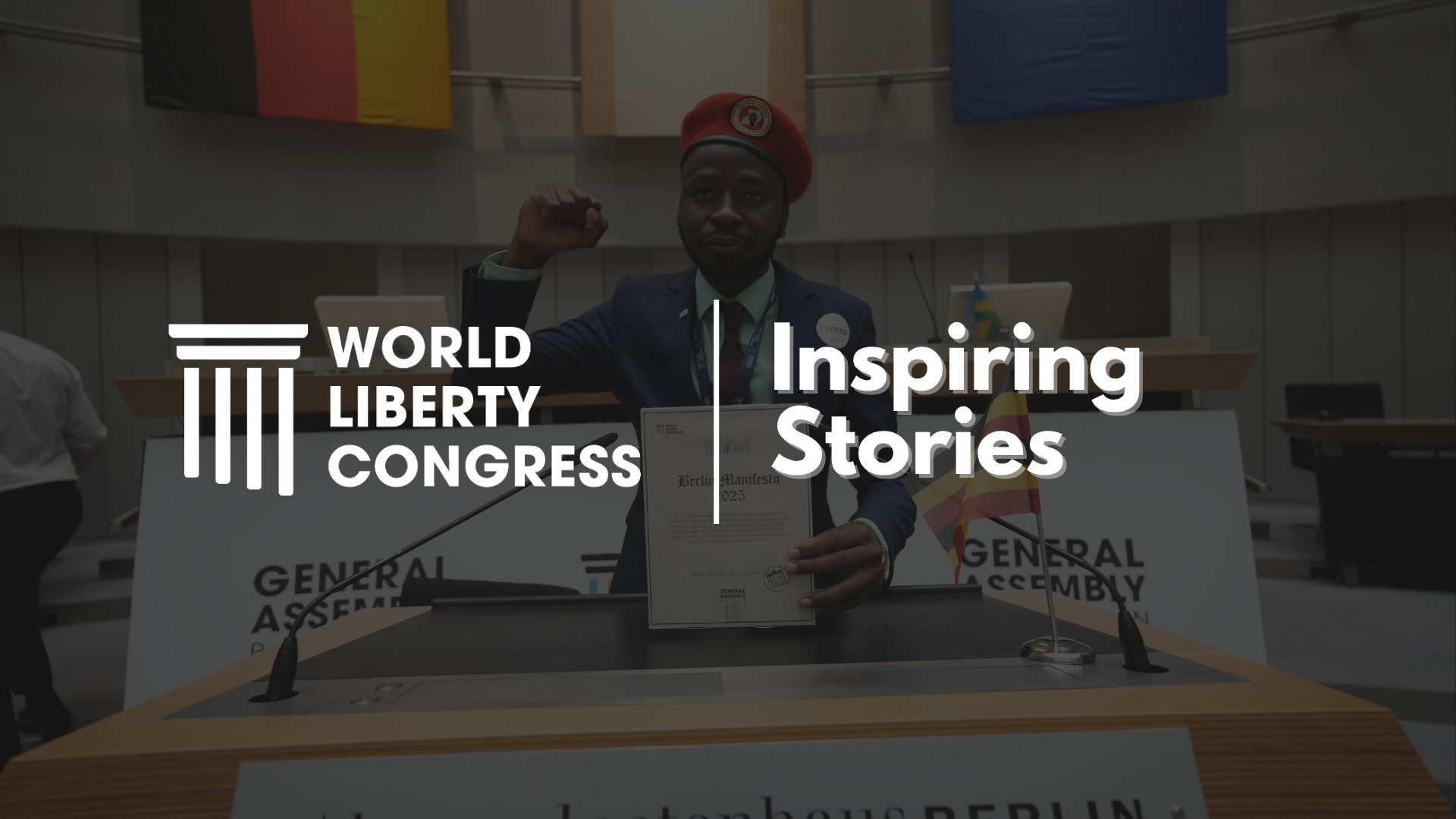
Few people are better positioned to explain why that network matters than Dr. Anyama Berliner, a physician, pro-democracy activist, and the Regional Secretary for Sub-Saharan Africa of the World Liberty Congress.
From the Lecture Hall to the Ballot Box
Dr. Berliner’s path into activism began not with a political awakening, but with a practical grievance. As a top-performing student admitted to medical school on national merit in Uganda, he noticed early on that the government stipends promised to scholarship students were being withheld without explanation. Rather than accepting the situation, he began organizing — communicating clearly with his fellow students, urging peaceful demonstration over confrontation, and building a reputation for transparency and follow-through that his peers could rely on.
“When students want to strike,” he recalled, “I tell them no, let’s give them two days, then we go to protest, and if we are protesting, it’s not going to be violent. We come with words. We present our issues.”
That measured approach earned him an unusual degree of trust within his university, eventually leading him to contest for the position of guild president, the highest elected office in the student body, a role recognized nationally and one that has historically served as a pipeline into Ugandan political life. He ran on the ticket of the National Unity Platform, the opposition party led by Bobi Wine, in a region of the country where no opposition candidate had ever won election. The campaign that followed illustrated, in stark terms, the conditions under which pro-democracy activists operate in Uganda. His posters were removed from campus. Supporters were offered cash bribes to abandon his campaign. Security forces were deployed on election day. The vice chancellor received a call instructing him to remove Dr. Berliner’s name from the ballot entirely. A law student serving as election commissioner refused to comply. Dr. Berliner won, becoming the first opposition-aligned candidate in the history of the region to do so, and in doing so attracted national media attention and the congratulations of senior opposition figures, including members of parliament.
The experience, he says, shaped his understanding of what sustained activism actually requires. “If you are standing for something, be ready to stand alone. And if you are standing for the truth, be ready to find a very strong resistance.”
The Regional Picture
Since completing his medical degree and his internship, during which he also led a nationwide peaceful demonstration against unfair compensation policies for medical interns, resulting in the government reversing its decision, Dr. Berliner has continued to expand his work as a regional voice for democratic accountability. In his role as Regional Secretary for Sub-Saharan Africa, he maintains active relationships with opposition politicians, civic leaders, and fellow activists across Uganda, Kenya, Zimbabwe, Sudan, and Rwanda.
The picture he paints of the region is a serious one. Uganda recently passed legislation prohibiting citizens from receiving funding from outside the country without approval from the executive, effectively giving the ruling government veto power over which pro-democracy organizations can receive international support. More than fifteen civic society organizations, many of which provided free legal assistance to activists, have been suspended. In Zimbabwe, legislators are advancing a proposal to extend presidential term limits to seventeen years. A prominent former finance minister there was recently arrested simply for organizing community education sessions. In Rwanda, an opposition leader remains imprisoned, and Aimable Karasira a Rwandan singer, academic, YouTube commentator, and outspoken government critic died in prison.
“There is a lot of frustration in the region,” Dr. Berliner said plainly. “The civic space is continuously shrinking, and intolerance toward opposition politics is growing.”
Why the World Liberty Congress Matters
It is precisely because of conditions like these that Dr. Berliner views the World Liberty Congress – and the Youth Liberty Congress in particular – as a genuinely important resource for activists in the region. He offered several concrete reasons why.
The first is the network itself. The WLC brings together activists, dissidents, and democratic reformers from across the globe, people who share similar challenges and who can offer one another strategic perspective, moral support, and practical guidance. “When you don’t have people to draw inspiration from, things become hard,” Dr. Berliner said. “Here we have people with tested experience, people who understand the dynamics of what it means to be in activism, what it means to be in opposition politics.” For activists operating in isolation within their own countries, that kind of community is not a luxury, it is a strategic asset.
The second is training. The WLC offers its members practical education in areas directly relevant to their work, including international law and, increasingly, financial technology. In environments where governments are moving to control or monitor traditional banking channels, the ability to transact securely and independently has become a matter of activist survival. Dr. Berliner himself has completed training in Bitcoin and uses it as a working tool. “I can convert Bitcoin in five minutes and use it right here,” he said. “Where do I get these lessons? Through the WLC.” For activists in countries now passing laws to restrict foreign financial transfers, this kind of knowledge is not theoretical, it is operational.
The third is platform and recognition. The WLC gives members a legitimate forum in which their voices and their region’s realities carry weight. Members have contributed to formal statements and policy documents on behalf of entire regions. They have been recognized and awarded for their contributions to democratic life. “You are going to have a platform with people who treat you as a colleague,” Dr. Berliner said, “with the intention of ensuring that you learn from them, and that your opinion matters.”
Finally, there is the strategic dimension of a decentralized global network. In a moment when authoritarian governments are cooperating across borders to suppress dissent, the WLC offers the beginnings of a coordinated counter, activists in Zimbabwe, Sudan, Kenya, and Uganda in communication with one another, sharing resources, and building the kind of resilience that no single government can easily dismantle.
The Case for Youth
Running through all of Dr. Berliner’s reflections is a consistent conviction about the particular importance of engaging young people in this work. In Uganda, he notes, people under thirty-five represent roughly 75% of the population. Excluding them from democratic life is not only unjust, it is strategically counterproductive for anyone who wants to see the region change.
“As a youth,” he said, “it is easier to stand on principle, because you have less to lose.” But beyond that, he sees young people as the foundation upon which a longer-term culture of integrity in public life can be built. “If we have young people who stand on principle, it will change the dynamics of politics, and these people will nurture the ones who come after them. We shall build a generation that runs politics and leadership on integrity.”
That is, in essence, the mission of the World Liberty Congress youth wing in Sub-Saharan Africa. It is not simply about opposing any one government or supporting any one candidate. It is about building a durable, principled, globally connected generation of leaders, one that is prepared, when the moment comes, to govern differently.