
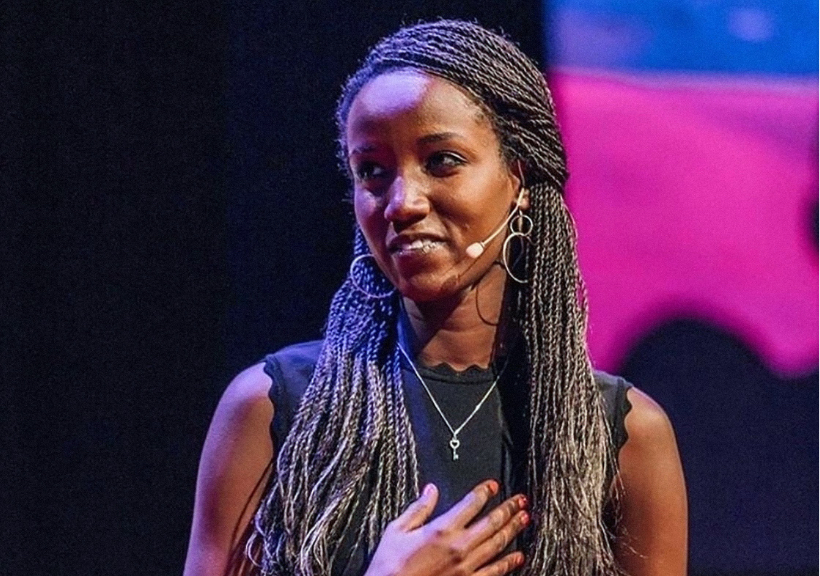
Carine Kanimba is a resilient survivor of Rwanda’s 1994 genocide, where her father, Paul Rusesabagina, heroically saved over 1,200 lives in his hotel, a story later immortalized in the film Hotel Rwanda. In a harrowing turn of events, her father was forcibly taken to Rwanda in 2020 and unjustly imprisoned for speaking out against the tyranny of the Rwandan president. As a dedicated global human rights advocate, Carine, alongside her family, led the #FreeRusesabagina campaign, shedding light on her father’s wrongful detention and ultimately securing his release in 2023 after almost 3 years as a political prisoner.
Carine was honored with the Heroes of Democracy Award from the Renew Democracy Initiative in April 2023 and the Global Magnitsky Justice Award for Outstanding Young Human Rights Activists in November 2023. Carine remains an active advocate for justice, human rights, and global liberties.
Hotel Rwanda
Her parents were killed during the genocide, and her foster father — who later became the protagonist of a Hollywood film — was kidnapped by intelligence agents. That is the story of Rwandan human rights activist Carine Kanimba.
When Carine was seven and her sister Anaïse was eight, their parents showed them photographs of strangers and said, “Girls, these are your biological mom and dad. They were killed in the genocide because they were Tutsi. We adopted you.”
By that time, Carine already understood what genocide was and what had happened in her homeland. She was born in Kigali, the capital of Rwanda, in 1993. In 1998, her family moved to Belgium. Carine didn’t remember the genocide — she was only a year old when Rwandans from the Hutu tribe killed her parents, along with nearly a million fellow Tutsis.
But she grew up living with the shadow of the genocide, because everyone her family interacted with carried this unbearable trauma. The genocide followed Rwandans wherever they went — through memories of lost loved ones, recurring nightmares, and the paralyzing fear of what they had endured.
More than a Thousand Saved in the Hotel des Mille Collines (Hotel of a Thousand Hills) Carine’s adoptive parents, Paul and Tatiana, told the girls what had happened. Their biological parents had been warned to leave their home in Kigali — it was too dangerous. But when everyone — their mother, father, the two girls, and their nanny — stepped outside, gunfire erupted. It was a trap. Their father was killed instantly and left lying in the street.
Their mother, the girls, and the nanny ran back into the house and stayed hidden there quietly until evening. That night, the killers returned, breaking into houses in search of survivors, intent on leaving no one alive. Their mother hid the girls in a closet. She was dragged from the house and shot dead.
A few days later, the nanny took one-year-old Carine and her two-year-old sister to an orphanage. Within days, relatives — Paul and Tatiana — came to take them in. Carine and Anaïse’s father was Tatiana’s brother. Tatiana’s husband, Paul Rusesabagina, was Hutu.
“I remember Mom sitting us down on the bed, sitting between Anaïse and me, and showing us the photographs,” Carine recalls. “At first, I didn’t understand who these people were. My sister started crying. Mom explained several times that these were our biological parents and told us how they had died. And then I started crying too. I couldn’t stop for days — my tears wouldn’t end. And then I began to hate. I hated the extremists who had killed my parents and hundreds of thousands of others. I didn’t know the killers by face, I had no idea what they looked like, but I hated them.”
It took me ten years to piece together the story of my family. I had to find out everything: which refugee camp we had ended up in, how long we had stayed there, which organization had helped the refugees, and who had fed my sister and me in the camp. And the moment I learned the truth about my biological parents, it was a shock — a deep pain. Perhaps, had I discovered it later, it would have been an even greater trauma.
Growing up in a mixed family, with a Tutsi mother and a Hutu father, Carine learned from an early age the importance of national reconciliation in a country still deeply divided. Her foster father, Paul Rusesabagina, spoke of this repeatedly. Yet the Hollywood film Hotel Rwanda, which would later tell the story of Paul’s heroism, was still years away. Fame and global recognition were far from his mind. During the genocide, his priorities were clear: to save his Tutsi wife, her relatives, and as many people as he could.
The final tally: 1,268 lives saved, all thanks to Paul. Not only Tutsis, but also Hutus who opposed the genocide and could have fallen victim to reprisals. Paul welcomed everyone seeking refuge into the Hotel des Mille Collines in Kigali, which, for a time, became a citadel in the midst of the genocide. Paul bribed security forces and militia members from the Interahamwe to leave the hotel alone and not storm it. He offered them generous drinks — alcohol stocks at the hotel were untouchable, serving as currency for bribing killers.
The Hotel des Mille Collines held firm. Those who took shelter there survived.
“We had been living in Belgium since 1998, but I always knew I wasn’t Belgian — I was Rwandan,” Carine recalls. “At home, we always spoke Kinyarwanda. From an early age, my foster parents told me about the genocide. Even though I didn’t immediately learn the full truth about my own family, I still understood what genocide was. I knew how it unfolded. I knew how Tutsis hid. I knew how ordinary people helped many of them survive. But I could never comprehend the level of hatred that drives one person to pick up a machete and kill another. There is simply no acceptable explanation for that — perhaps only a historical context for the divisions.”
“When Belgian colonizers arrived in Rwanda in 1914, the Hutu and Tutsi coexisted peacefully. The Tutsi primarily raised livestock, while the Hutu farmed the land. The Belgians noticed the two ethnic groups and placed the Tutsi in power. Essentially, the Tutsi supported the colonial administration and the subjugation of the Hutu. That marked the beginning of the historical divide, when colonial authorities started favoring one group over the other.
Later, a Hutu uprising targeted both the colonial rulers and the Tutsi, who had supported their policies. When Rwanda gained independence and the Hutu came to power, the process reversed — the Tutsi were oppressed. Many were forced to leave the country. And in April 1994, when the plane carrying the presidents of Rwanda and Burundi was shot down near Kigali, the genocide began.”
Not Just Reconciliation, But Justice
Carine emphasizes repeatedly: it wasn’t Hutu killing Tutsi — it was a well-armed extremist group. Her father, the famous Paul Rusesabagina, always stressed that Rwanda’s foremost need was national reconciliation. Raised by a Hutu father and a Tutsi mother, Carine understood this from an early age.
When Paul Rusesabagina began speaking publicly about the need for reconciliation, he became a target for the new regime. President Paul Kagame took charge of Rwanda’s new regime. Kagame, a Tutsi born in 1957, fled with his parents to Uganda when he was two years old. He grew up in Uganda, joined the National Resistance Army, and played a role in the rebellion that ultimately secured the rebels’ victory. In exile, Kagame also founded the Rwandan Patriotic Front, which included Tutsi émigrés. In 1994, the RPF, led by Kagame, entered Rwanda — after several failed attempts in previous years — and stopped the genocide.
Kagame has ruled Rwanda ever since, although he formally became president in 2000. Since then, election results have been highly predictable: on average, 95 percent of the vote in his favor, and in 2024, a staggering 99.18 percent.
The guerrilla hero who entered the country as a liberator eventually became a typical African authoritarian leader. Arrests of opposition members, secret prisons, torture, and the mysterious deaths of political opponents have all become the modus operandi of the Rwandan government. In those early days after the genocide, however, a Tutsi hero like Paul did not need yet another Hutu hero.
Kagame did not want anyone — especially a Hutu — to be seen as a savior during the genocide. Any reminder that Hutus could save lives, or do anything good, had to be erased. Kagame and his RPF came to stop the genocide, but in the process, they killed many innocent people — both Tutsi and Hutu. And those who dared speak about their murdered or missing relatives also disappeared — taken away, never to be seen again.
My father, however, always said that Rwanda needed not just reconciliation, but justice. Justice not only for the Tutsis, but also for the Hutus. He called for investigation and accountability, and for this reason, he became an enemy of the new regime almost from the start.
That was just the beginning. Then the people who had taken refuge in the Hotel des Mille Collines and survived began to tell their stories. Kagame realized that he could not erase this history, could not make it forgotten, could not pretend it had never happened.
He offered my father positions in the government. “You could be a minister, an ambassador, anything you want,” he said, “just join my team.” But my father stood firm and principled: only reconciliation and justice. He insisted that the current government, too, is accountable for its crimes, and that it was time to bring this chapter to a close. Kagame was furious, and after threats to my father’s life, we had no choice but to flee Rwanda.
A third source of Kagame’s animosity toward my father was the Hollywood film Hotel Rwanda. The hero of the movie about the Rwandan genocide was hotelier Paul Rusesabagina, not guerrilla leader Kagame. He could not tolerate that. Especially after the film, people around the world began to learn about my country. University students everywhere studied the genocide through my father’s book. And the proverbial cherry on top: the United States awarded my father the Presidential Medal of Freedom, one of the country’s two highest honors.
Imprisoned on a Private Plane
The Rusesabagina family moved from Belgium to the United States. Carine lived a relatively privileged life — she attended university and later worked as an investment banker in New York. Paul Rusesabagina, meanwhile, immersed himself in politics. In exile, he founded the Rwandan Movement for Democratic Change, published a book, and gave lectures at universities and international human rights conferences. He spoke out about the situation in Rwanda, human rights violations, and the country’s dictatorship.
Then he was kidnapped. The plane Paul was supposed to take from the UAE to Burundi departed from Dubai, only to land in Rwanda, where he was arrested.
That was not the first attempt on his life or liberty. Carine recalls that in 2006, her father was pursued by a car in Belgium in what appeared to be an assassination attempt, and in 2018, while in the U.S., he was targeted with poisoning. In the intervening years, the Rwandan authorities repeatedly tried to fabricate criminal charges and discredit him.
Paul was, of course, vigilant. But he is a devoutly religious man. When all other attempts to reach him — through criminal or judicial means — failed, they sent a priest.
It wasn’t until after my father’s arrest, during the campaign for his release, that we learned the full details. For two years, a bishop from Burundi had been visiting him. My father is a devoutly religious man, and the doors of his home were always open to a clergyman. He could never have suspected that a man of the church could be involved with the Rwandan intelligence services.
For two years, the bishop gained my father’s trust. He said that because Burundi and Rwanda share a similar history and the same ethnic groups — Hutu and Tutsi — Burundi also needed reconciliation. And it would be valuable if my father could fly to Burundi and speak there. He said: “You must come. Together, we will address the people of Burundi. That will be a vital humanitarian mission.”
My father agreed. It never crossed his mind that this was a carefully planned operation by the Rwandan intelligence services that had been in motion for two years. Still, he told the bishop that he could not fly to Burundi — it was too close to Rwanda and therefore too dangerous. The bishop replied, “You won’t have to take a commercial flight — it’s really too dangerous. I’ll arrange a private plane for you. I have many friends who can safely get you to Burundi. You’ll fly to Dubai first, and from there, a private plane will take you to Burundi.”
Being a religious man, Paul Rusesabagina trusted him. On August 29, 2020, he flew from Houston to Dubai. There, he boarded a private plane operated by a Greek company. He asked the Greek pilot, “We’re flying to Burundi, right?” The pilot confirmed: yes, to Burundi. Just to be sure, he asked a flight attendant. She said, “Of course, to Burundi,” and offered him a drink. After that, Paul drifted off.
When he came to, he saw Rwandan soldiers boarding the plane. Through the window, he recognized the familiar Thousand Hills, the land of his birth. Paul shouted, hoping to get the attention of the pilot and the flight attendant — he knew he needed at least some witnesses. But the pilot stepped out of the cockpit and calmly wished him luck. The crew was part of the operation.
Paul Rusesabagina was handcuffed, removed from the plane, and thrown into the back seat of a car. From the airport, he was taken to a prison in Kigali, where he was charged with terrorism and then tortured for four days. Under duress, he signed a confession.
American Bar Association representatives, George Clooney’s “Not On Our Watch” foundation, and other observers were allowed into the country for the trial. “The trial was staged like a show trial of the century,” Carine recalls. “They even had translators into English, but their task was to frame my father as a terrorist for the Western observers. Yet no one could produce a single piece of evidence.”
“Maybe it’s just a nightmare?”
After three months of hearings, the court delivered its verdict: 25 years in prison. Carine’s life flipped upside down, shattering the routines and schedules she had known for the second time. She left her successful career as an investment banker and threw herself entirely into securing her father’s release — and that of other political prisoners. Many human rights defenders come to their work this way: when your own life falls apart, you start saving others — first your loved ones, then strangers. And you never return to your old job.
“I used to hear my father speak a lot when I was a child,” Carine recalls. “When he talked about dictatorship, about how the current regime crushes dissent, I didn’t really take it that personally—I lived in New York, I had a successful career. Then one morning, I turned on CNN and saw my father in handcuffs. The headline read: ‘Paul Rusesabagina, hero of Hotel Rwanda, arrested and charged with terrorism.’
He looked exhausted, his eyes red as if he hadn’t slept in days. I thought: this can’t be true — this couldn’t happen! My father couldn’t possibly be in Rwanda; he had already survived assassination attempts in Belgium and the U.S., and there was no way he would have gone there willingly. The phone rang nonstop — friends, colleagues, relatives calling: ‘Did you hear? They’re accusing your father of terrorism.’
I knew I had to set the record straight, to explain to everyone who my father really is, what he has done, and what the Rwandan regime does to those who speak out. But above all, I had to bring him home.
At first, Carine reacted unusually: the shock was so overwhelming that she decided to climb back into bed and try to sleep, hoping it was just a nightmare — and that when she woke again, Paul would be home in Texas. She fell asleep. But thirty minutes later, when she woke again, she realized the truth: this was no nightmare. Paul Rusesabagina was in a Rwandan prison.
At that moment, she knew nothing yet about the priest, the Greek pilot, or the Rwandan intelligence operation. She understood immediately that she could not go to work or interact with clients as if nothing had happened — her father needed to be rescued. She had to assemble a rescue team. The first members were relatives and friends, who immediately asked: “What can we do for Paul?”
The first step was to reach out to the U.S. State Department and the Belgian authorities, since Paul Rusesabagina is a citizen of both countries. Then they contacted international human rights organizations, seeking support and advice on how to proceed. Carine could think of nothing else. She kept imagining her 67-year-old father, handcuffed in a prison cell of a state that had already tried to kill him multiple times. She envisioned the worst that could happen to him in that place.
“I knew the trial was a sham, and that legal avenues were useless — especially since my father wasn’t even allowed to hire his own attorneys,” Carine recalls. “The state provided attorneys, so my job became shaping public opinion. I reached out to the media, who covered the trial and highlighted its illegality. I called on parliaments and governments around the world to speak with one voice, demanding the immediate release of my father and other Rwandan political prisoners. I testified before the European Parliament and the U.S. Congress. I spoke with representatives of legal associations across Europe and Africa. I reached out to everyone I could, trying to get the charges against my father recognized as unlawful. Meanwhile, they kept torturing him in prison.”
A happy ending doesn’t mean it’s truly over
The public campaign to free Paul Rusesabagina lasted two and a half years. Carine received support not only from Western governments and human rights organizations, but even from the actors of Hotel Rwanda, who wore T-shirts calling for Paul’s release. Rwandan intelligence tried to intimidate or discredit her — the main argument from regime propagandists: “She hasn’t lived in Rwanda since childhood; what could she possibly know about our country?”
Rwandan agents infected Carine’s phone with Pegasus spyware, tracking her every move in real time as she moved from one government office to another, rallying support. Officials tweeted that Carine Kanimba “deserves a golden machete.” Yes, she was scared—but she knew her father was far more frightened and in far greater danger.
Finally, Carine Kanimba efforts helped to get the United States to block aid to Rwanda. She proved that much of the money intended for humanitarian purposes actually went toward strengthening and supporting the ruling regime. The U.S. Senate Foreign Relations Committee blocked the funds allocated for aid to Rwanda. The message was clear: no money would flow until Rusesabagina regained his freedom. And dictators’ hearing works peculiarly — they only pick up signals like this; other warnings tend to go unnoticed.
In August 2022, U.S. Secretary of State Antony Blinken traveled to Rwanda to meet with President Paul Kagame. After the talks, Kagame promised that Rusesabagina would soon be released. He was finally freed from prison in March 2023, along with twenty other political prisoners.
“In prison, everyone knew my father’s story. Before his release, they told him, ‘You’ve seen everything that happens here. You know that many of us are prisoners — not just of politics or journalism, but even of our own thoughts. Don’t stay silent — use your voice. Speak for those of us who remain.’
My father walked free, but nothing ended — Rwandan prisons still hold political prisoners, and we continue to fight for them, now together. Every day, I receive dozens of messages pleading for help. I learned so much during the two-and-a-half years I spent fighting for my father’s release. I gained invaluable insight. While he was in prison, I stayed in contact with three Rwandan journalists who provided me with invaluable support. Today, two of them are in prison, and the third was killed. In Rwanda, speaking out, thinking freely, and sharing information can be deadly. That means my voice must be even louder. I have a duty to speak for those who cannot be heard.”
(Stories from the book “Fighting for Freedom in the World” – Author: Iryna Khalip)