
By WLC Leadership Council member, Bota Jardemalie.
You may know Paul Rusesabagina as the man who inspired Hotel Rwanda. He is also the father of Carine Kanimba, my fellow member of the World Liberty Congress. Since 2005, the Rwandan government threatened him repeatedly, with break-ins and intimidation, to the point that Belgian intelligence provided him protection. Then Rwanda turned the international cooperation system against him: a “mutual legal assistance” (MLA) request that led Belgian authorities to search his home in Kraainem, Brussels, in 2020, and his private documents were passed to Rwanda. The search was carried out by Belgian police in the presence of Rwandan agents. Paul Rusesabagina had protection in Belgium, but no way to fight back against the MLA request. The law had a gap: he could not appeal the search of his home or the seizure of his documents. Soon after, he was lured to Dubai, abducted with no extradition process at all, and taken to Rwanda, where he says he was tortured. The documents seized in Belgium and transferred to Rwanda were then used as “evidence” in a sham trial.
One crucial point : under the MLA, Belgium never assessed this so-called “evidence” at all; essentially everything found in his house was handed to the regime. Rwanda’s message was simple: “Belgium handed over the evidence, so the case is proven.” The dirty work was done in Rwanda; the clean appearance was borrowed from Belgium. In other words, Belgium had unwittingly given a fabricated case the stamp of legitimacy the moment it complied with the MLA request.
This is what should be called “injustice laundering.” A regime fabricates a political case at home, then uses international cooperation channels to push it into a Western legal system, where it suddenly looks credible. This is exactly the danger I have spent seven years fighting. Kazakhstan abused the same MLA system against me, twisting it into a tool of transnational repression.
And my fight changed Belgian law. I am a political refugee in Belgium. After Kazakhstan’s secret service failed to abduct me or have me extradited from Belgium, it took my brother hostage on fabricated charges, tortured him, and held him in solitary confinement. Then it sent Belgium an MLA request, asking it to assist in the investigation of the case. Surprisingly, Belgium complied. When my home was searched in 2019 at Kazakhstan’s request, by the Federal Police and in the presence of Kazakh agents, Belgian law gave a refugee like me no way to challenge it in court, the same gap that had left Paul Rusesabagina defenceless. But I appealed anyway. In its judgment 1/2022, the Constitutional Court of Belgium recognised that people in my situation must have a right to appeal, and called on Parliament to change the law. On 3 June 2026, the Court of Cassation made my victory final, confirming that Kazakhstan’s request against me was politically motivated. (https://lalibre.be/dernieres-depeches/2026/06/03/cour-de-cassation-les-motivations-politiques-du-kazakhstan-sont-confirmees-dans-laffaire-jardemalie-4LBH7YFO6BDCNPXMWJ6MTBJPUM/)
This means that today, people targeted this way in Belgium can go to court and challenge a political decision to cooperate with an authoritarian regime.
Both cases share the same anatomy. An authoritarian regime dresses up political persecution as an ordinary criminal request, and a democratic state risks becoming the instrument of that repression. The difference is that, thanks to years of litigation, victims in Belgium now have a legal weapon to fight back: the right to appeal that my case secured.
The lesson is clear. The EU must stop letting its legal system be weaponised by regimes like Kazakhstan and Rwanda. Legal safeguards are not a technicality. They are what stands between a political dissident and a prison cell and tortures abroad. The fight against transnational repression goes on.
More on the Rusesabagina case: https://cfj.org/wp-content/uploads/2023/07/Paul-Rusesabagina-_Fairness-Report-April-2022.pdf
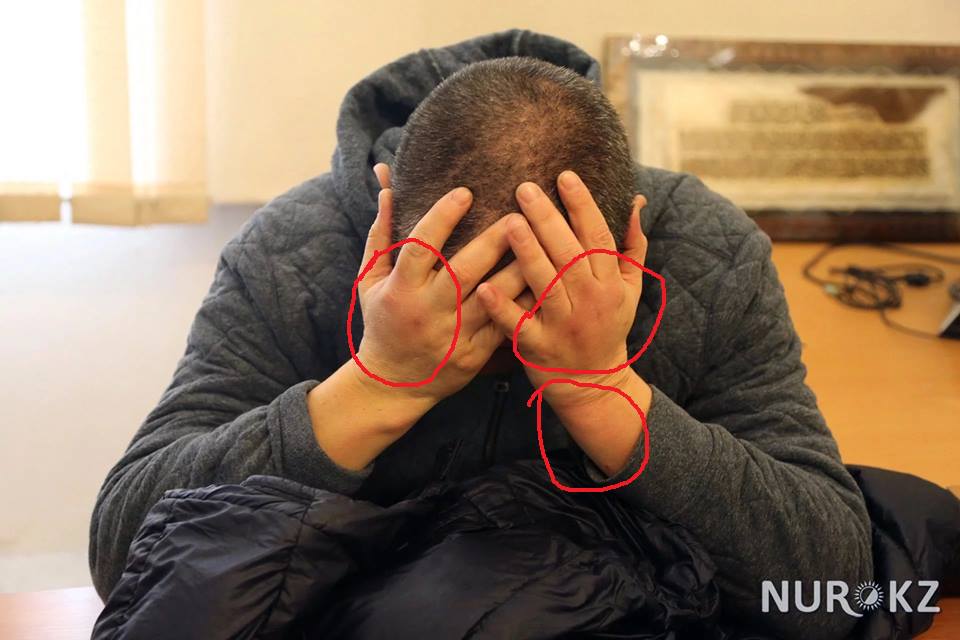
In the photo: my brother after being tortured in 2018. In an attempt to prove that my brother had not been tortured, the authorities showed him to a select group of local media. However, he was not allowed to show his face.