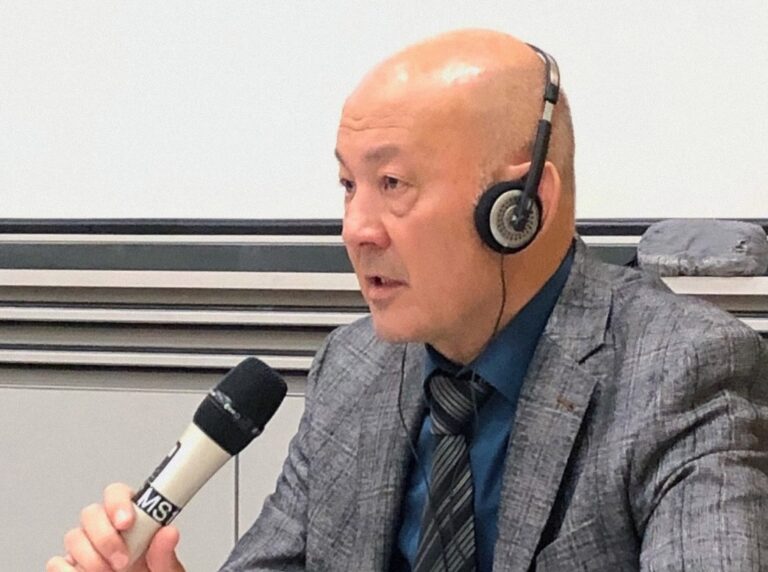

A Tajik journalist and human rights defender currently serving as editor-in-chief of Azda.TV, a Tajik-language news network based in Poland that works to promote freedom of expression and democratic values.
He is also president of the board of directors of the Foundation for Intercultural Integration, which assists refugees with resettlement in Poland. In 2014, he founded the NGO Eurasian Dialogue in Lithuania and launched the independent news channel Central Asian TV the same year.
He has worked extensively to advocate on behalf of refugees, immigrants, and political prisoners in Tajikistan, Russia, and the European Union. He has also worked with the UN Human Rights Committee, the European Parliament, and the OSCE, to advance the rights of Tajik political prisoners.
A Rebel With a Pencil
A Tajik Journalist Built a TV Studio in Europe. In Response, Rahmon’s Regime Took Away His Father’s Passport and Property. The Story of Muhamadjón Kabirov
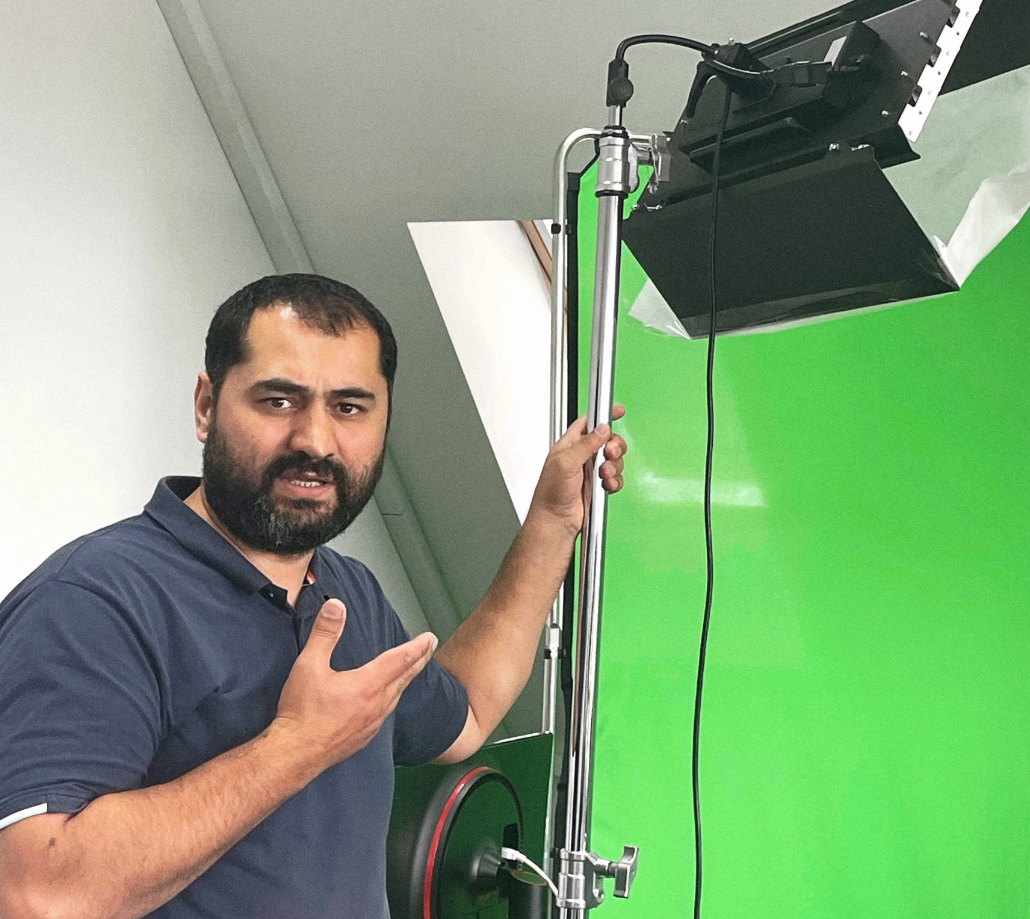
Inside an ordinary office building in Warsaw, there’s a tiny TV studio. When the news is being recorded there, people in neighboring offices have no idea what’s being said: the anchor speaks Tajik. That is Azda TV, an independent Tajik television channel operating in exile.
“Come on in, let me introduce you. That is our anchor, Firuz Khait. His father is serving a life sentence. We’re about to start recording — want to see how we work?” That’s how I’m welcomed to the studio by the head of Azda TV, journalist and human rights defender Muhamadjón Kabirov.
The studio has four young staffers and equipment that’s more old than new — ancient, in fact. They don’t even have mixing devices—neither audio nor video. A USB stick is inserted into the camera, and once the recording is finished, that same stick is used in a computer for editing. That’s their entire workflow. But they record the news every single day. Once a week, they record in Russian, with a Ukrainian anchor coming in to host. The rest of the time, the broadcasts are all in Tajik.
An Exile in Absentia
Muhamadjón Kabirov never dreamed of living abroad, reporting on Tajikistan from a safe distance, or knocking on every European door to speak about repression and political prisoners. He was born into a religious family that deeply loved its homeland. He studied first in Iran, then in the United States, and later in Moscow, but he always knew his journey would ultimately lead back to Tajikistan. That was where, as an educated young man with both Western and Eastern training, he could bring real value to his country.
Many think this way — whether they leave to study or work abroad, or flee with nothing but a backpack to escape the security forces waving an arrest warrant.
Still, not every broken plan is the work of the security forces. Muhamadjón’s life might have turned out very differently if his wife had received a U.S. visa. But she was refused. While he was pursuing his master’s degree in America, his wife was unable to join him. So he decided to complete his studies in Russia, since no visa was required.
The Kabirov family settled in Moscow. Muhamadjón studied political science and international relations, but before he could even finish his master’s degree, he was offered a job in journalism. At the end of 2014, a new pan-Central Asian television channel, Central Asia TV, was being launched in Moscow. Journalists from across the region were invited to join. The idea was that the project would not only cover news, traditions, and culture from Central Asian countries, but also help reshape public attitudes toward migrants from those nations.
In February 2017, Muhamadjón flew to Turkey to visit relatives for the weekend. On Saturday, when only one staffer was present, security forces arrived with a search warrant and seized all the equipment. Central Asia TV rented two small offices in the same building — one on the second floor and another directly above it on the third. The second floor had a sign with the channel’s name, but the third floor didn’t. They had just expanded and hadn’t put it up yet. Since the raid skipped the third floor, they were able to preserve a small part of the equipment.
Since the vast majority of the channel’s staff were Tajik, the Tajik security services had likely ordered the raid.
“I became a refugee in absentia—in Turkey,” Kabirov recalls. “The security forces came to the TV office, and while I was trying to figure out what to do, my wife went to the local administration (we were living in the Tula region, and we had residence permits in Russia) over a minor issue. An employee there told her, ‘It’s strange—your documents are all in order, we know your family, and I just can’t understand why the FSB is interested in you.’ That’s when I realized I could never go back to Russia. And definitely not to Tajikistan—by then, my colleagues and I were already considered enemies of the people, simply for reporting as a normal media outlet, not as propagandists. Rahmon doesn’t forgive that. Journalists and bloggers are his personal enemies.”
From Kebab Shop to the Airwaves
Muhamadjón had a Schengen visa, and he flew from Istanbul to Warsaw. He didn’t want to go too far west—like many other refugees, regardless of their country of origin or the source of persecution, he hoped he might need to lie low somewhere safe for a while. He filed for refugee status a year after emigrating — only then did he fully realize that there was no home to return to.
His wife and children had no visas. His daughter was two, his son just eight months old. Khadjar Kabirova, his wife, undertook an extremely hazardous journey: with the little kids, she made it to Brest and boarded the Brest–Terespol train. At that time, there was no pandemic with closed borders, and no war with sanctions. Trains ran regularly between Brest in Belarus and Terespol in Poland. The two cities are only seven kilometers apart — the train ride took 21 minutes. Belarusian officials didn’t check visas at boarding. But upon arriving in Terespol, Khadjar applied for political asylum. Her application was rejected, and she was sent back. (Later, hundreds of Chechens traveled the same route every day, hoping to claim asylum, often living right in the waiting hall of the Brest train station.)
The Kabirov family “traveled” like this for exactly 14 days. They returned to Brest, rented a room for the night, and then went back to the station. All the while, Muhamadjón was calling and writing to every authority he could. It felt like hitting a brick wall. Then, after two weeks, a door suddenly opened: the authorities accepted the Kabirovs’ application and let them enter Poland. In the end, his wife and children received refugee status even before Muhamadjón.
Working on human rights issues in exile became easier: he started speaking at conferences about repression and political prisoners in Tajikistan. Journalism, however, proved more complicated.
Before long, a small group of Tajik activists escaping repression had gathered in Warsaw. Those who hadn’t been journalists before — it didn’t matter, they could learn. Muhamadjón and his colleagues started working together. Or rather, volunteering: after their regular jobs, they would gather and record programs “on the fly.” Muhamadjón worked in a kebab shop, a vegan restaurant, and on construction sites. Everyone else had similar day jobs. So journalism was limited to the evenings.
Initially named Central Asia News, the project soon became too ambitious; after a year, they realized they didn’t have the time or resources to cover the entire region. They decided to focus on their homeland — Tajikistan. That’s how the YouTube channel and website Azda TV were born, broadcasting in both Tajik and Russian.
The Tajik-language news anchor, Firuz Khait, had been arrested in Dushanbe while still in school. His father, Mahmadali Khait, the deputy chairman of the Islamic Renaissance Party of Tajikistan (IRPT), was arrested in 2015. At that time, all party leaders and around 200 supporters were detained, accused of involvement in an attempted military coup. The party was declared a terrorist organization. Mahmadali Khait and another deputy chairman, Saidumar Khusayni, were sentenced to life in prison.
At the time, Firuz photographed all the pages of the verdict and sent them to Tajik opposition figures abroad. They, in turn, made the verdict public. But the state security officers traced the photos back to their location by a fragment of carpet visible in the shots. Authorities detained Firuz and his mother. Three days later, they were released — with threats and warnings. Firuz had no choice but to leave. His mother stayed behind: she is allowed a brief visit with her life-sentenced husband every six months and can deliver supplies for him.
Meanwhile in Tajikistan
You can go years living in exile and slowly start to believe you’re safe. But if a dictator still has your relatives back home, they automatically become hostages the moment the regime declares you an enemy.
Muhamadjón’s father was a farmer: orchards, fields, machinery, livestock, back-breaking work from dawn to dusk. But when his son launched a studio in Poland and started broadcasting programs about events in Tajikistan, the regime seized all the family’s property. The authorities confiscated the land, the farm equipment, Muhamadjón’s apartment, and property registered in his mother’s name. The authorities left his father with the old family home, where he has lived under house arrest for the past two years. He is under strict orders not to communicate with his son.
“My mother managed to leave. We were really hoping to get my father out. Two years ago, he received a visa. But at the airport, they took his passport and annulled it. They even revoked his driver’s license. He’s a hostage in the classic sense. And he’s completely prohibited from communicating with me. There was only one time — that was before the passport was seized, in 2017, before my speech at the OSCE — when a call came from my father’s number. I didn’t answer. I knew immediately something was wrong. A couple of minutes later, my aunt in Moscow called: ‘Muhamadjón, your father’s in the police station, they’ve taken him. They want you to stop speaking. They forced your father to call you.’ I went ahead and spoke anyway. I couldn’t miss the chance to talk about what’s happening in Tajikistan. You have to understand, it feels like Tajikistan no longer exists on the map. As if Tajikistan doesn’t exist: no dictatorship, no Rahmon, no repression. Rahmon travels on official visits to Western countries without anyone demanding that he frees political prisoners. At best, the UN Human Rights Committee softly “recommends.” Sometimes I’m overwhelmed with such despair! I think: what can I accomplish with a pencil in my hand? I should’ve picked up a rifle and become a basmach (combatant), honestly.”
Safar Kabirov, Muhamadjón’s father, was held in handcuffs for two days without any charges, threatened with prison and torture. Then he was released. But can it really be said that Safar Kabirov is free? Without family, without property, without the work he had built over the years, and now even without a passport or driver’s license.
Before becoming a farmer, Safar Kabirov had worked as a bus driver. He also lost his first job as a bus driver, along with his driver’s license. At the same time, the relatives of another Tajik activist in exile, Islomiddin Saidov, were evicted from their home. The Saidovs were told, “This is punishment for your son.”
A year later, the same thing happened to the relatives of human rights activist Shabnam Khudoiddodova. Shabnam herself was granted political asylum in Poland after being detained in Belarus under an Interpol red notice issued at the request of the Tajik authorities. She spent nine months in a Belarusian detention center before being released and allowed to travel to Europe.
In 2018, ahead of another conference appearance, Shabnam’s mother, daughter, and brother were taken to the police, had their documents confiscated, and were warned that all of them were “under surveillance.” After Shabnam’s speech at the OSCE conference, Tajik security forces sent a crowd of “outraged citizens” to the school where her daughter Fatima studied. The “citizens” followed the girl all the way home, calling her a terrorist. The family’s documents were returned only a year later — and then confiscated again a year after that, when Shabnam’s mother, daughter, and brother tried to leave Tajikistan.
Arrests and threats are a common experience for the relatives of many Tajik activists who remain in the country. Taking hostages as revenge is a typical and striking feature of the Tajik regime.
Muhamadjón still communicates with his father—rarely, cautiously, without direct calls — through several relatives, across multiple countries, using different messaging apps.
Transnational Repression and Article 307
Besides using the stick in the form of detaining relatives and issuing threats, Rahmon’s regime actively employs the carrot: promises of amnesty or pardon in exchange for returning. Muhamadjón recalls that in 2020, this tactic brought opposition figure Sobir Valiev back to Tajikistan. Valiev is the deputy chairman of the opposition movement Group 24.
“It turned out Sobir had studied in the same class as the president’s son. Well, his classmate persuaded him to return. However, authorities soon opened a new criminal case against him. That is also standard practice for Rahmon: ‘We’ll grant you amnesty, come back,’ and then they open new cases and imprison you. And if they abduct you—well, then you get a long sentence.”
Tajik opposition activists are also targets of abduction in Russia. That country is often the easiest destination for Tajiks trying to leave, and in the past, many sought safety across the border there.
Russian security services have never commented on the sudden disappearances of Tajik activists, only for them to later appear in Dushanbe prisons. Tajik authorities, in turn, claim that these individuals returned to the country voluntarily.
From Europe, Tajiks are deported after being denied asylum. Blogger Farhod Negmatov, who has resided in Sweden since 2019, is the latest example. Despite multiple asylum applications and appeals, he was ultimately deported to Tajikistan, where authorities recently sentenced him to eight years in prison. Last November, opposition figure Dilmurod Ergashev was deported from Germany and immediately taken into custody in Dushanbe. Activist Farukh Ikromov, expelled from Poland last year, was sentenced to 23 years in prison.
Those who cannot be abducted or persuaded to return can be killed. Back in 2015, one of the opposition leaders, Group 24 founder Umarali Kuvvatov, was shot dead in Istanbul. Tajikistan demanded his extradition, but Turkey refused to hand him over. A bullet proved far more effective than paperwork demanding his return. Istanbul police arrested the main organizer of the killing, and he ultimately received a life sentence. The other four suspects managed to leave Turkey.
Incidentally, it was in Turkey—long considered a relative haven for Central Asian emigrants — where, last March, Group 24 leader Sukhrab Zafar and his colleague Nasimjon Sharifov went missing.
It later turned out that they had been mysteriously transported from Turkey to Tajikistan. In November, Zafar was sentenced to 30 years in prison, and Sharifov to 20 — both under Tajikistan’s most commonly used charge against dissidents, Article 307 of the Criminal Code: “incitement to violently overthrow the constitutional order using the Internet.”
“Last fall, I got a call from someone I’d known about 20 years ago,” recalls Muhamadjón Kabirov. “He said Tajikistan’s security services had approached him with an offer to go to Poland and assassinate me. They promised that after carrying out the job, he and his family would be well off and never need anything again.
According to him, he told them he needed to think about it—and that very night, he fled Tajikistan. Of course, I reported the call to the police. Honestly, I didn’t expect it to affect me so profoundly. We all know that Tajik security services hunt down journalists, human rights defenders, and activists. We know about the kidnappings and killings outside Tajikistan. We know you have to stay vigilant and never let your guard down anywhere in the world.
But when someone tells you so casually, ‘I was supposed to kill you,’ it’s paralyzing. For two months, I couldn’t work normally. The police, naturally, explained how to behave, what to avoid, and where to call if I noticed anything suspicious. Still, the fact that the authorities are aware of the threats doesn’t make things any less stressful. Over the past year, I’ve had to change apartments twice after noticing strange people near my building. We were also forced to move our office because we detected surveillance.”
Enemy of Turkmenbashi
That is how the dictatorship transformed an ordinary mechanical engineer into a fighter against the regime. It took an accusation of conspiracy, prison, a life in exile, and even a death threat.
I visited Azda TV just as they were settling into their new office. Only the equipment was still old.
“Sometimes even Tajik opposition figures in exile refuse to give us interviews,” Muhamadjón laughs. “They call us ‘grant eaters.’ Want me to tell you about grants?”
He explains how Azda TV operated on a volunteer basis for two years. Then, one of the international foundations supporting civil society offered Muhamadjón the chance to apply for a grant. He did—and received $45,000 for a year. A third went to rent, and the rest covered operating costs and staff salaries. The salaries were roughly equivalent to what cashiers earn at Żabka, a chain of small, low-cost stores in Poland.
The workday at Azda TV is over: the program has been recorded and edited, and everyone can head out. And the “grant eaters” disperse—back to their other jobs. Some get behind the wheel of a taxi, others make deliveries for courier services.