
By Elizabete Cuna, WLC member.
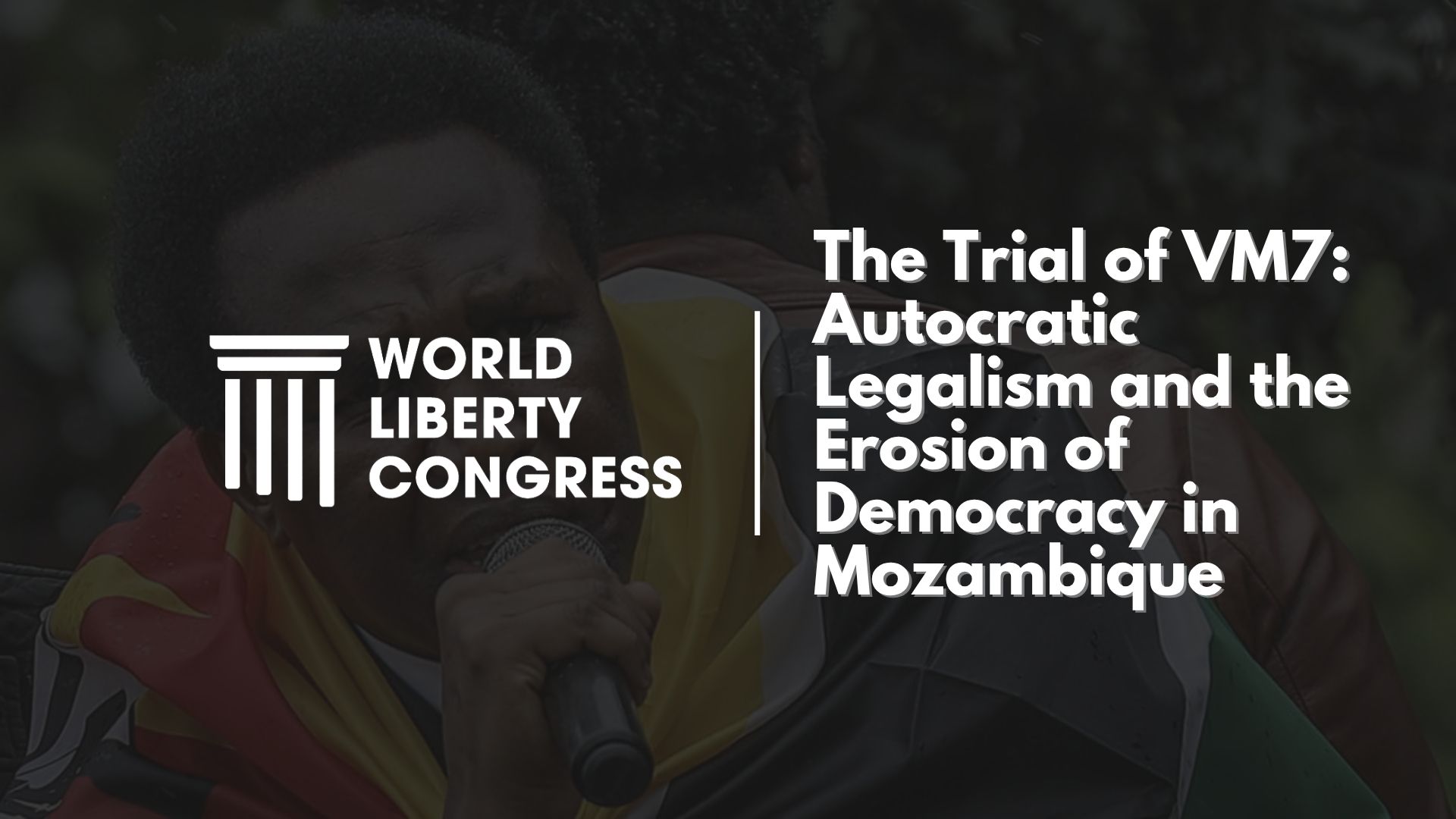
On 17 November 2026, Venâncio Mondlane, mostly known as VM, will stand before the Supreme Court to face five criminal charges stemming from the widespread post-election uprisings that shook the nation following the disputed 2024 presidential vote.
The state’s indictment is heavy: public advocacy of crime, incitement to collective disobedience, public instigation, instigation to terrorism, and incitement to terrorism.
The controversy surrounding the trial deepened when the Supreme Court rejected Mondlane’s request for live television, radio, and digital broadcast of the proceedings, while also prohibiting audio and video recording. The decision has intensified concerns over transparency in a case of exceptional national importance.
Yet, reducing the VM7 case to a routine criminal prosecution is a profound mistake. This is not simply a trial of an opposition leader. It is a calculated deployment of what scholars term Autocratic Legalism, the manipulation of judicial institutions to eliminate political competition under the cloak of the rule of law.
Mozambique’s state institutions, its judiciary, and the legitimacy of its political framework now face an unprecedented test. The central question before the court is not whether political leaders should enjoy immunity from prosecution because no actor in a constitutional republic should be above the law. The real question is whether the state is applying the law equally, or whether it is using the penal code as an instrument of political survival while granting its own security forces total impunity.
A Crisis Rooted in the Ballot Box
The origins of the current political standoff trace back to the October 2024 general election. When Daniel Chapo, candidate for the long-ruling FRELIMO party, was declared the victor by electoral authorities and the Constitutional Council, Mondlane rejected the official tally, alleging widespread electoral fraud.
What followed was not an ordinary political dispute, but a prolonged national crisis characterized by mass strikes, youth-led street demonstrations, and a heavy-handed state response. Human Rights Watch and regional observers documented grave systemic abuses: extrajudicial killings, arbitrary detentions, and the routine use of lethal force against nonviolent marchers. Between October 2024 and March 2025 alone, at least 400 people were killed, including Elvino Dias, Mondlane’s lawyer with Paulo Guambe, with state authorities failing to conduct transparent or credible investigations into a single case.
The human cost extends far beyond Mozambique’s political class. Families have been forced to bury young protesters; communities remain under police occupation; and thousands of citizens have been left with a glaring unanswered question: Who holds the state accountable when it turns its weapons on its own people?
The Facade of Democratic Institutions
Mozambique possesses all the external hardware of a modern representative democracy: A parliament, scheduled elections, a multi-party system, and constitutional courts. But formal institutions do not, on their own, guarantee a democratic state.
A democracy’s true strength is revealed when political power is genuinely contested. Can citizens demonstrate without facing live ammunition? Can opposition movements organize without their leaders being targeted by death squads? Can independent journalists expose state corruption without fearing for their lives?
Freedom House’s 2026 assessment classifies Mozambique as “Partly Free,” citing severe restrictions on civil liberties, a compromised judiciary, and the structural dominance of FRELIMO, which has ruled without interruption since independence in 1975. After half a century of single-party dominance, the line separating the ruling party from the apparatus of the state has effectively dissolved.
The Human Body Count of Resistance
The most alarming dimension of Mozambique’s political environment is the deliberate, targeted violence directed at opposition movements.
The National Alliance for a Free and Autonomous Mozambique (ANAMOLA) reports that 57 of its members have been killed since the movement’s formal establishment in August 2025. While partisan casualty figures require rigorous independent verification, dismissing them out of hand is an act of state negligence. When a registered political movement reports dozens of targeted killings over a brief timeframe, an independent democracy’s obligation is immediate, transparent investigation.
The recent death of Ilídio Facitela Gustavo, an ANAMOLA organizer in Inhambane Province, demonstrates the immediate danger facing dissenters. Abducted on 11 September and found dead the following day, Gustavo was, according to Mondlane, scheduled to testify as a defense witness.
The Illusion of Justice
The decision to ban live television broadcasts of the proceedings, paired with the ongoing violence against defense witnesses like Ilídio Facitela Gustavo and his killing, exposes the stark asymmetry at the heart of this crisis. By shielding the trial from public scrutiny while granting state violence total impunity, the government reveals the trial of VM7 for what it truly is: a judicial instrument designed to preserve ruling-party dominance under the guise of law.
The trial on 17 November will not measure Venâncio Mondlane’s guilt; it will measure whether Mozambique’s judiciary retains any independence or if autocratic legalism has fully extinguished the nation’s democratic promise.