
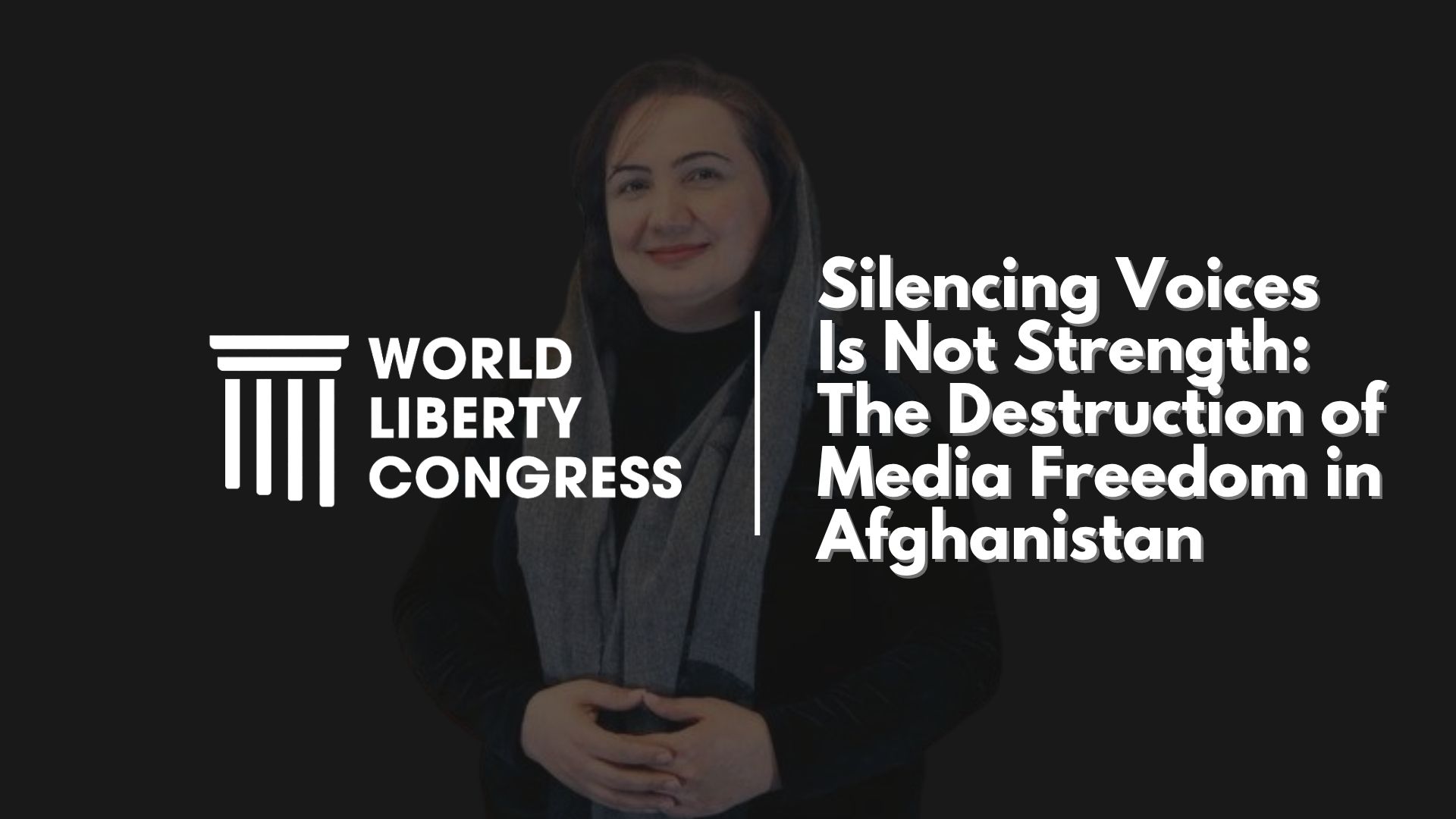
By WLC Vice-President, Shukria Barakzai.
Freedom of expression and a free press are not gifts from governments. They are rights. And they are among the foundations on which any meaningful democracy is built.
Journalism matters because it allows us to ask questions that those in power may not want to answer. It exposes corruption and abuse, challenges official narratives and gives citizens the information they need to make decisions about their lives and their future. That is also why authoritarian rulers so often begin by going after the media. This is no longer only an Afghan concern. Something worrying is happening globally.
The V-Dem Democracy Report 2026 finds that the level of democracy experienced by the average person in the world has fallen back to where it was in 1978. Around 3.4 billion people—41% of the world’s population—now live in countries undergoing autocratisation.
Freedom House offers another sobering measure: 2025 marked the twentieth consecutive year of decline in global freedom. Political rights and civil liberties deteriorated in 54 countries, while only 35 recorded improvements. Behind these numbers is a simple warning. Democracy is losing ground, while authoritarianism is becoming more assertive. And one of the first casualties is almost always the same: the freedom to speak, to report, to disagree and to question power.
Afghanistan: How Far Repression Can Go
Five years after the Taliban returned to power, I believe we need to ask a question that is both simple and uncomfortable: Does Afghanistan still have a free press? Perhaps the question goes even further. Does Afghanistan today have a genuinely public media space—one that reflects the lives, concerns and diversity of Afghan people rather than simply the wishes of those who rule them?
Afghanistan now ranks 175th out of 180 countries in Reporters Without Borders’ 2026 World Press Freedom Index. Freedom House gives Afghanistan only 8 out of 100 for political rights and civil liberties and classifies the country as “Not Free.” But rankings tell only part of the story. Free media is not simply about having television channels broadcasting or newspapers carrying headlines. A media outlet can exist without being free.
Real media freedom means investigative journalism. It means access to information and the freedom to verify facts. It means asking officials difficult questions and speaking to different sides of a story. It means political and social debate. It also means education, culture, entertainment, music and sport. And it means women. Women must be able to report the news, present programmes, interview officials, debate public issues and tell the stories of other women. Today, much of that space has disappeared.
According to RSF, the Taliban have issued more than 20 directives and decrees restricting journalism. More than two-thirds of Afghanistan’s approximately 12,000 journalists have left the profession. Women have suffered disproportionately: within the first year of Taliban rule, more than three-quarters of female journalists had lost their jobs. RSF documented 141 journalists arrested or detained during the first three years of Taliban rule. And the pressure is becoming more severe.
Under criminal provisions introduced in 2026, insulting Taliban leadership can result in six months in prison and 20 lashes. Insulting the Taliban’s Supreme Leader can result in one year in prison and 39 lashes. Even contact with opponents of the authorities—or failing to report such contact—can carry criminal consequences. For a journalist, this strikes at the very heart of the profession.
How can you investigate those in power if speaking to their critics may itself become a crime? How can you verify information without talking to different sources? And how can ordinary people distinguish fact from propaganda when asking the wrong question may result in prison or lashes?
When Women Are Silenced, Afghanistan Loses Half Its Story
The removal of women from Afghanistan’s media is not simply about women losing jobs. Something much larger is being lost. When women disappear from newsrooms, radio stations and television screens, the stories of millions of Afghan women become easier to ignore.
Who investigates what happens to a girl prevented from going to secondary school or university? Who reports on women denied employment or freedom of movement? Who tells us about women’s health, poverty, violence and access to justice? Who reports on women in culture and sport when women themselves are being removed from these spaces?
A media environment that excludes women cannot fully tell Afghanistan’s story. For me, this is also personal. I come from a generation that witnessed the extraordinary growth of Afghanistan’s media after years of repression. We built newspapers and magazines in difficult circumstances. A new generation of journalists emerged. Women sat behind microphones and in front of television cameras. Ministers and politicians faced uncomfortable questions. People argued about politics. There was music. There was humour. There was sport. There were disagreements.
Afghanistan’s media was far from perfect, but there was a public space in which different ideas could meet. That mattered.
An Old Formula in a World That Has Changed
There is another contradiction that authoritarian rulers seem unwilling to recognise. They are trying to control information with methods from the past while living in a world transformed by technology.
Censorship is an old formula: control the media, hide uncomfortable facts, repeat the official version, punish dissent and hope that eventually people will stop asking questions. It may produce silence for a while. But silence is not belief.
And today, controlling information is more difficult than ever. Technology has torn through borders that once contained information. Social media has changed who can publish and who can be heard. Citizen journalism means that an ordinary person carrying a mobile phone can document an event and share it with the world within minutes.
Now artificial intelligence is producing another profound transformation—changing how information is found, translated, analysed, verified and communicated. The younger generation understands this instinctively. They do not experience the world only through what a government television station chooses to show them. They communicate across borders, compare experiences, follow events as they happen and form their own judgments.
You may close a newspaper. You may take a woman off television. You may ban music. You may arrest a journalist. But you cannot easily rebuild the walls that technology has already torn down. That is why censorship, secrecy, propaganda and the monopoly of information are not only repressive; increasingly, they are unrealistic.
Silencing Voices Is Not Strength
The Afghanistan I speak about today is governed by rulers who appear to fear freedom while demanding ever greater control over information and public life. But silencing people is not strength. It is fear dressed as authority.
A government confident in its legitimacy should not fear a journalist carrying a microphone. It should not fear a woman appearing on television. It should not fear an investigative report, a political debate, a song or an uncomfortable question. It should certainly not need prisons and lashes to protect itself from words.
The old mentality of control, censorship, secrecy and denial must eventually give way to something very different: accountability, access to information, freedom of expression, freedom of thought and the right of citizens to question those who exercise power over them.
Suppressing these rights does not make grievances disappear. It pushes them beneath the surface.
When people have no peaceful way to express frustration, when journalists cannot expose problems, when political debate is closed and when those in power refuse accountability, pressure accumulates.
And history has taught us something important: silence imposed from above must never be confused with consent from below.
No society can absorb unlimited pressure indefinitely. When peaceful avenues for expression, participation and reform disappear, frustration can eventually turn into deeper instability and social rupture. Afghanistan may be an extreme example, but the warning is much wider.
Authoritarianism rarely arrives in a single moment. It advances gradually. A journalist is intimidated. A newspaper is closed. An independent institution is weakened. A critic is labelled an enemy. Censorship becomes normal. Citizens are told that giving up some freedom is necessary for security and stability.
Then another freedom disappears. And another. This is how democratic space shrinks.
At a time when global democracy is already in retreat, Afghanistan should not be viewed only as an isolated tragedy. It should also be seen as a warning. There can be no lasting stability without accountability. And there can be no genuine accountability when citizens are denied access to information and journalists are punished for asking questions.
Five years after the Taliban returned to power, therefore, the question is larger than whether Afghan journalists are free. Do Afghan people still have the right to know the truth? And perhaps the question the rest of us should ask is equally important: Will we defend democracy while we still have the freedom to defend it?
Freedom of expression gives democracy its voice. Independent journalism gives citizens the means to hold power accountable. Silencing those voices does not make rulers stronger. It tells us how much they fear an informed, questioning and free society.
Shukria Barakzai | Media Freedom in Afghanistan